Wednesday, May 19, 2021

Finding the Mother Tree - the connectedness of nature.

Review: Finding the Mother Tree, by Suzanne Simard 
 by Clement Kent 

Debuting in fourth place on the New York Times Best Seller list for hardcover non-fiction is not bad at all for a book on fungi and trees. Keeping me reading avidly throughout three hundred pages is pretty good. But changing the present and future course of how we plant, care for, and harvest trees will be the best impact of all for this book by UBC forest scientist Suzanne Simard. 

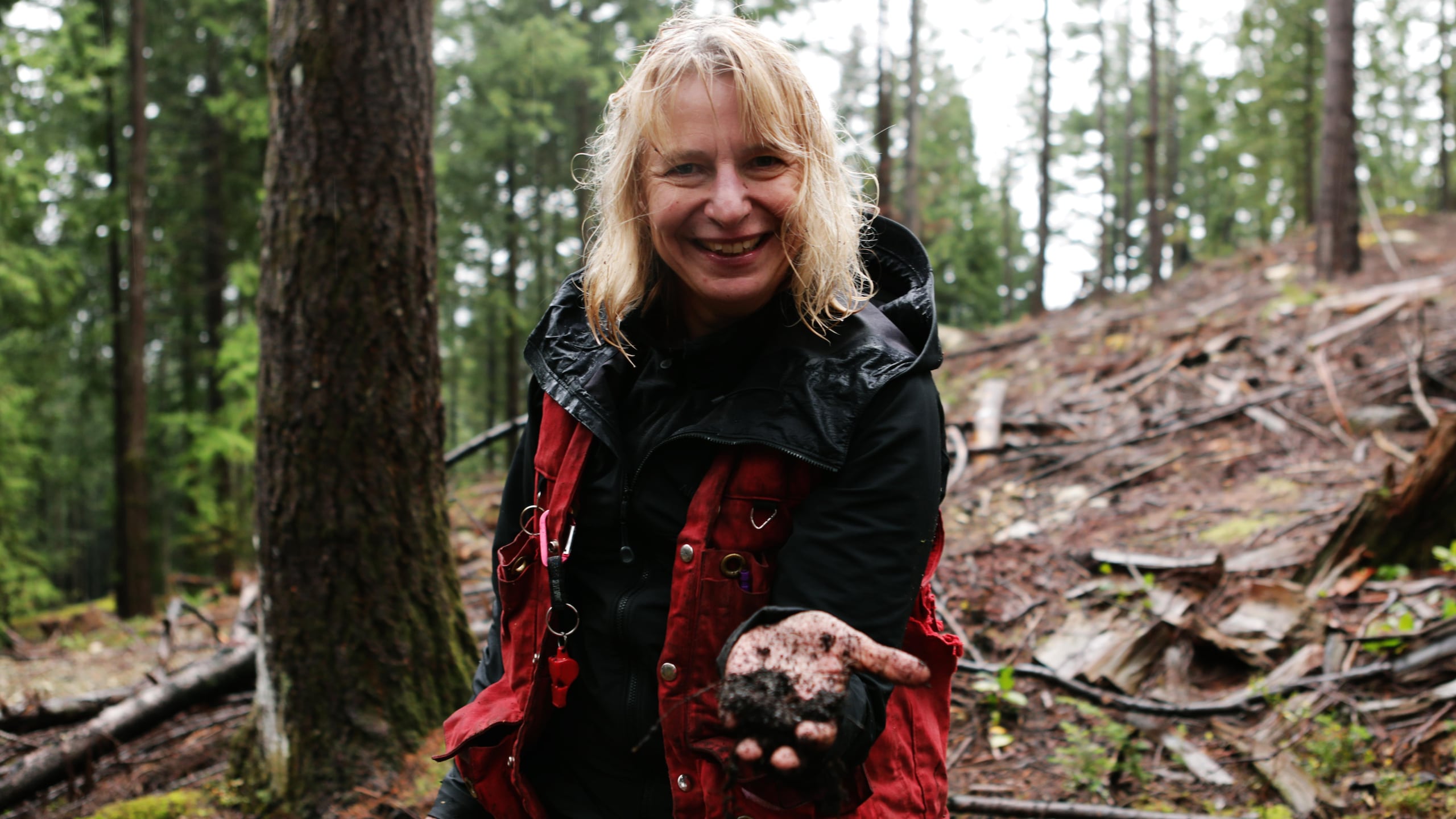
Suzanne Simard, from Radio Canada

I knew enough about Simard to buy two copies (from Indigo or your local independent bookstore), one for keeping and the other for circulating among friends. Although I normally relax by reading fiction, this was my sole reading material until I finished it. Simard’s storytelling mixes her life growing up in the mountains of British Columbia with the developing story of her scientific discoveries about how forest trees share support, warnings, and other messages with their neighbours via the underground network of fungi that go from the roots of one tree to the roots of the next. When she first proved that birch and fir in the BC forest can send carbon (as photosynthetically manufactured sugars) through fungi to each other in the most prestigious science journal in the world, the editors of Nature featured her paper on the cover and coined the phrase “the Wood Wide Web” to describe it. 

But the profound impacts of Simard and others’ work describing mutualistic relationships in the forest isn’t what will keep most readers going. Simard has written a very readable autobiography. Her family roots in the BC mountains as loggers and ranchers are lovingly described. Some of the climactic moments occur when her brother competes at rodeos. Family photos going back a century show what logging in BC used to look like, and Simard’s personal experience of how forests her own family had logged regenerated helped inspire her scientific questions. Going from early childhood (the scene in which the family dogs falls into the outhouse pit is a classic!) to young adulthood, motherhood, family crises and her life-threatening struggle with breast cancer and her mature life goals, the development of Suzanne Simard as a person, as a young woman fighting the scientific and forest business establishment, and finally as a central figure of modern forest science will engage you fully. 

To finish this review, I can’t do better than let Simard’s words from the last page of Finding the Mother Tree inspire you: 

We have the power to shift course. It’s our disconnectedness – and lost understanding about the amazing capacities of nature – that’s driving a lot of our despair, and plants in particular are objects of our abuse. By understanding their sentient qualities, our empathy and love for trees, plants, and forests will naturally deepen and find innovative solutions. Turning to the intelligence of nature itself is the key. 

It's up to each and every one of us, Connect with plants you can call your own. If you’re in a city, set a pot on your balcony. If you have a yard, start a garden or join a community plot. Here’s a simple and profound action you can take right now: Go find a tree – your tree. Imagine linking into her network, connecting to other trees nearby. Open your senses. 


Finding the Mother Tree: Discovering the Wisdom of the Forest, by Suzanne Simard. Allen Lane publishing, May 21 2021.

Wednesday, December 23, 2020

Fake Honey: two generations of learned beekeepers strike back

 Last year I was at Apimondia in MontrĂ©al, a big international convention of beekeepers, bee researchers, and suppliers of beekeeping and honey making equipment. One of the big events at Apimondia is the judging of honeys submitted from around the world. I walked by the exhibit area before the judging:

failed tests at Apimondia 2019

I was flabbergasted to see so many spots on the display shelves occupied not by jars of honey but by failure notices:


OK, what does "this exhibit has failed laboratory examination" mean? Well, it could be incompetence pure and simple - for instance, gathering honey from your hives before it has lost enough water will make it thin and more likely to spoil.

But in some cases it may mean that the honey was adulterated, diluted with corn syrup, full of banned chemicals like antibiotics or pesticides, etc. I was really shocked that so many honey producers would pay big bucks to ship their honey to Montréal, pay to enter it in the judging, and have it fail testing.


blackberry honey from BC
I was reminded of this on the solstice yesterday as I put the last of a jar of British Columbia blackberry blossom honey on a toasted slice of our homemade bread. This stuff I knew was the real deal, not the least because of the atomic "Bruker" symbol on the label.

Atomic? Honey? Yes, this honey was tested on a Nuclear Magnetic Resonance (NMR) machine by TrueHoneyBuzz, a B.C. company started by two generations of learned beekeepers and businesspeople, Jerry Awram Ph.D and his son Peter Awram Ph.D.

The NMR machine is made by Bruker Scientific Instruments, and in spite of the alarming orbiting particles in the logo, it does not use any harmful radiation. In fact, one type of NMR machine is the MRI (magnetic resonance imaging) machines used in hospitals.

NMR uses something akin to a very low power microwave to stimulate molecules in the sample, which reveal themselves in peaks in the readout as the frequency is changed - just like turning the dial on an old-fashioned radio detects peaks at different frequencies - those are the radio stations. 

Each kind of molecule has its own peaks, so the chemical composition of the sample can be found. Now, since a large proportion of "honey" in stores (up to 76% in the US , up to 20% of "pure" Australian honeys, and up to 50% of honeys imported from Asia) are in fact faked in various ways, North American beekeepers and honey packagers have been looking at cleverer and cleverer ways of detecting fakes.

Jerry Awram, Ph.D.

Peter Awram, Ph.D.
This brings us back to the Awram family. Jerry Awram got his doctorate in the 1970s studying bumblebees. He went on to run a large family beekeeping business in Alberta.

At the time, honeybees on the prairie were killed off in the fall and beeks (short for beekeepers) started of from scratch each spring with bees imported from the U.S. or elsewhere.

Jerry moved the family business to Chilliwack BC where in the Fraser river valley, the bees can fly all through the mild winter. Some of these hives go back to Alberta in spring to harvest the canola blossom crop.

Peter Awram got his Ph.D. at the University of British Columbia in microbiology, where he still does research as a member of the BeeHIVE Research Cluster. But he and his father have pioneered the use of NMR in Canada for honey testing. I got my very nice blackberry honey sample from their booth at Apimondia, where they had posters explaining their method, and the results of some internet detective work they'd done on providers of fake honey ingredients in China.


Want to learn how to make fake honey? Just go to youtube, as their poster showed:

part of TrueHoneyBuzz poster at Apimondia 2019


They point out that you can order fake honey ingredients from large producers in China on an ascending cost scale. The fakes that can pass chemical tests are more expensive than the corn syrup with rice flour added. 


If you want to find out more about fake honey and the Awram's way of detecting it, you can try the CBC piece whose headliner writer had a little fun: A B.C. solution to taking the sting out of honey fraud